
Self-Help Won't Help
Or why your favorite self-help guru is trying to sell you protein shots.

It’s the start of the new year, and my inbox and social media are already unbearable.
Every email subject line is shouting at me. Reset your life. Optimize your habits. Become the calmest, richest, hottest version of yourself by February. Even the apps that promise mindfulness seem frantic, vibrating with urgency.
A meditation app I regularly use recently told me I spent 5,432 minutes with it last year, but recently I’ve lost my streak. In app speak, this means: get back to it, you lazy, dumb person. Immediately become mindful and optimize yourself.
This is perhaps why, when I did receive yet another email newsletter from a New York Times best-selling wellness guru checking in on my anxiety, my irritation reached its peak.
I not only unsubscribed but did something uncharacteristically pedantic. I filled out the little feedback form where they ask why you are leaving, and I wrote that their “emails about reducing my anxiety are giving me anxiety.”
This phenomenon is everywhere. This morning, as I was walking to a haircut appointment, I started listening to the latest episode of Emma Grede’s podcast, Aspire with Emma Grede.
The reason I listen to this podcast is simple: I’ve recently launched my own business, and I want to learn more about setting up a business from a woman who has set up many businesses. That’s it.
I’m not looking for woo-woo motivational talk. I’m not looking to optimize my mindset. I’m looking for practical advice.
Apparently, I was asking for too much.
Because Mel Robbins was the guest on her latest episode.
Oh my.
If, like me, you also suffer from a deep interest in how self-help and empowerment are used as a hook to sell people products, you’ll understand why I had to listen to the episode. Purely for research purposes. And maybe a little rage-baiting.
How I wish I didn’t.
For an hour and five minutes, Mel Robbins explained how everything she does is in service of helping people, people who are struggling, people who just want to feel better.
She also insisted that she never compares herself to others. That claim felt especially ironic, given this other podcast in which she openly admitted to comparing herself to every other author publishing books and feeling inadequate and anxious about falling behind.
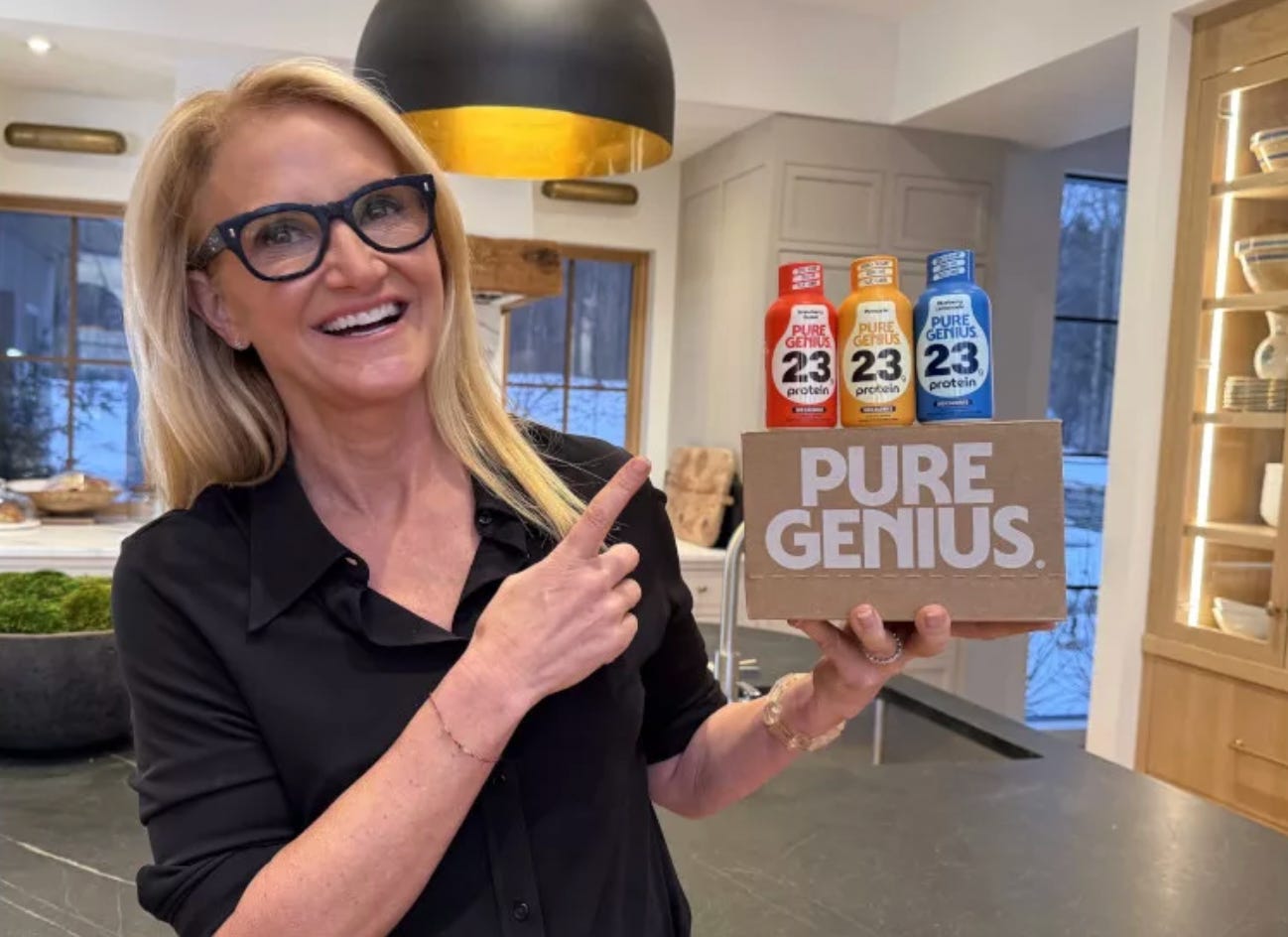
After a lengthy and self-aggrandizing introduction to her many virtues, she announced her latest offering to help the masses: a new protein shot.
I kid you not.
A new protein shot… to help women. Of course. Because in 2025, we can’t launch a business to simply sell high-quality products or to make money. All businesses are out there to help people.
You know what would be a convincing “help the people” enterprise? Not trademarking the protein shot so that the same allegedly best-in-class formula could be produced in labs all around the world for a cheaper price.
Like Jonas Salk, developer of the first successful polio vaccine, who famously chose not to patent it and forfeited all future profit for himself and his grandchildren. Why? To help people.
Same motivation, completely different results.
But I must be missing the point because Mel Robbins says you can even put this protein shot in your margarita!
What a great service to humanity…
The Self-Help Industry’s Fixation on Personalizing Systemic Failure
As someone who has consumed a lot of self-help books, I’ve come to realize there are two types of self-help literature out there.
One teaches you actual techniques. Like a book about meditation that teaches breathing techniques for people who deal with anxiety. A book that talks about introducing grace into everyday conversations in an increasingly polarized political climate. Recipes for insulin-resistant people who don’t want their medical condition to turn into full-on disease.
I like that kind of self-help because it doesn’t promise you that the breathing technique will cure anxiety or remove the cause of it, or that introducing less judgment into everyday interactions will transform the current political climate. Cooking a certain way will not give you a new pancreas, but is likely to improve your overall health in significant ways.
I have absolutely no issue with self-help literature that makes honest claims and introduces actual tools and techniques to improve people’s experiences in the world.
What I have an issue with is the other, more popular type. The kind of self-help that disregards all structural and systemic issues and tells you that you can simply believe, manifest, think, or feel your way out of everything.
My favorite example, which I’ve written about before, is Sheryl Sandberg’s Lean In. A demonic book, in my opinion, that told a generation of women to “lean in” to the demands of corporate work and never say no, never draw boundaries, if they want to succeed.
As if physical exhaustion were a personal failure rather than a human fact, the book preached showing up, staying productive into odd hours of the night, no questions asked.
The book disregarded the simple fact that the corporate world had to change for women to thrive, and instead put the onus on them to adapt to an objectively dysfunctional environment.
Coming from a powerful voice like Sandberg’s, can you imagine how vulnerable that made so many of us in environments already riddled with harassment and discrimination?
The same goes for the gazillion other self-help books that promise you can become a millionaire in ten simple steps, find a partner with a quick mindset shift, or fix your life with the latest fad diet.
The truth is, you need actual financial education to build wealth. You need to cultivate real self-worth to be in a respectful and meaningful relationship. And you need to invest in your lifestyle in serious ways to stay healthy.
You know what all of these have in common? A prolonged, not easy process that involves learning, introspection, and action. There are no quick or easy fixes.
This critique is interesting coming from me, because I do believe people have tremendous resilience and agency, and that if they wish, they can significantly alter their circumstances. Having said that, my belief in people’s potential doesn’t erase the systemic issues they’ll face along the way as a result of their identities and socio-economic circumstances.
I distrust people who sell me empowerment.
A lot of the self-help literature out there is rooted in a desire to fix, medicate, control, and manipulate unresolved discomfort, usually through quick fixes.
This ignores the fact that much of life is spent sitting with that discomfort, suspended between moments of great joy and deep despair. Much of what is meaningful or transformative comes only through extraordinary effort. These are two fundamental truths about life that the self-help industry prefers to conveniently overlook.
You fall in love. You get your heart broken. You find friends, and you lose them. The same goes for jobs and businesses. Some of us have babies. Some of us lose people we love. We experience trauma, we break cycles of trauma.
Threaded through all that joy and despair is a great deal of discomfort, uncertainty, and idle, mundane moments. You can use such moments as a compass to push you toward a new direction or to get to know yourself better.
Obviously, nobody wants these negative emotions. That said, we need to learn how to experience them. A cheesy analogy that I really like is the image of a surfer who skillfully rides waves. Waves rise, reach their peak, crash, and then rise again. Some surfers crash under those waves, others ride them, and some even chase bigger ones.
Without peaks and drops, like waves, humans simply flatline.
My outline for a self-help book which won’t sell
If any of the agents who follow me are interested, I’m in the market to publish my personal manifesto against protein shots, because what we don’t need is another quick powder to fix our lives.
What we need is the ability to afford high-quality produce, the time to prepare meals with our families, and green public spaces to move our bodies. None of which can be manifested into reality with magical thinking or a scoop and a shaker bottle.
Self-help won’t help, because self-help won’t change what life is: a continuum of everyday structural issues and emotional ups and downs that make up the delicious experience we call life.
If you enjoyed this article and my other content, please show your support — like, comment, restack, and recommend to help spread the word.
If you’re feeling extra generous today, consider becoming a paid subscriber to support my writing. Thank you! 🫶🏼
This is so disappointing. Everyone's hawking smthing these days. Did you see Ellen DeGeneris selling beauty stuff. ?
Love this, thank you. Coincidently the US govt released their latest nutrition guidelines today and they now highly recommend increasing protein 🤦🏻♀️😆 can’t make this up.